📘 Class 6 – Science (Curiosity, NCERT)
Chapter 1: The Wonderful World of Science
Questions are RED Answers are GREEN. Font is Comic Sans MS. Mobile-friendly size. MathJax ready.
🌟 20 Most Important Words & Meanings (Hindi only)
- Science – विज्ञान (दुनिया को समझने का तरीका)
- Curiosity – जिज्ञासा (जानने की प्रबल इच्छा)
- Observation – अवलोकन (ध्यानपूर्वक देखना)
- Experiment – प्रयोग (जाँचने के लिए करके देखना)
- Hypothesis – परिकल्पना (अनुमानित उत्तर)
- Analysis – विश्लेषण (परिणामों को समझना)
- Conclusion – निष्कर्ष (अंतिम फैसला)
- Universe – ब्रह्माण्ड (पूरा अंतरिक्ष और सब कुछ)
- Planet – ग्रह (सूर्य के चारों ओर घूमने वाला पिंड)
- Star – तारा (अपना प्रकाश देने वाला आकाशीय पिंड)
- Galaxy – आकाशगंगा (तारों का विशाल समूह)
- Material – पदार्थ (जिससे वस्तुएँ बनी हों)
- Energy – ऊर्जा (काम करने की शक्ति)
- Temperature – तापमान (गरम-ठंडा माप)
- Steam – भाप (उबलते पानी की गैस)
- Ice – बर्फ (जमा हुआ पानी)
- Life – जीवन (जीवित होने की अवस्था)
- Cuisine – व्यंजन-शैली (खाने की परंपरा)
- Environment – पर्यावरण (हमारे चारों ओर की परिस्थितियाँ)
- Scientist – वैज्ञानिक (वैज्ञानिक विधि से खोज करने वाला)
📝 Important Notes (Chapter Gist)
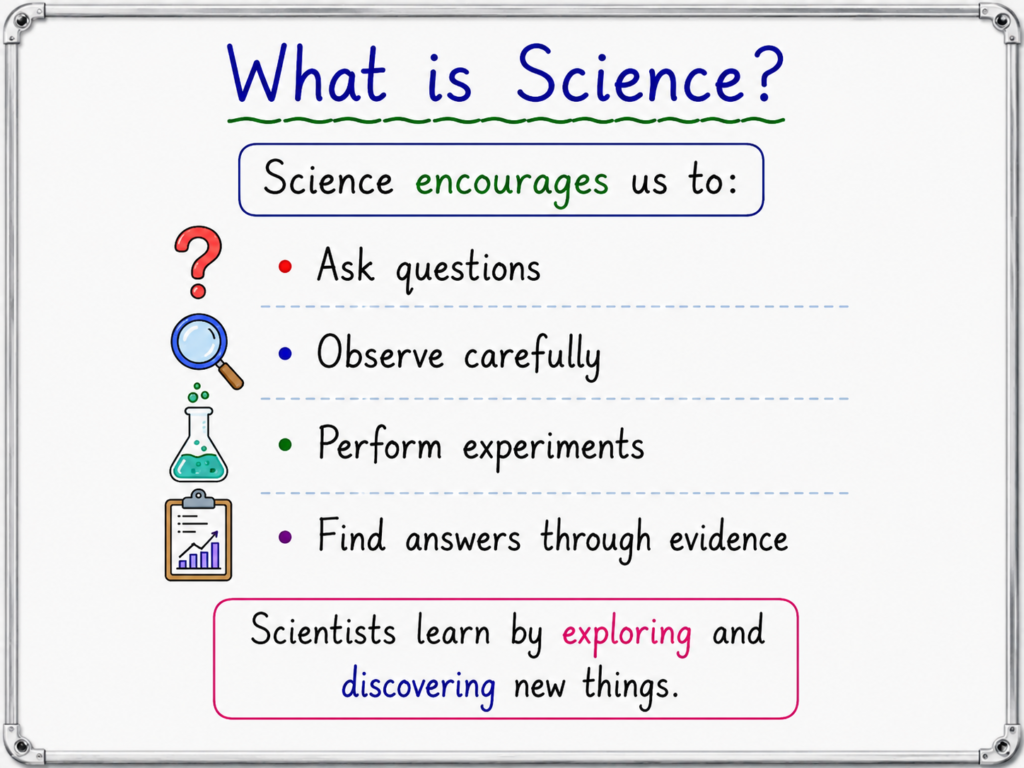
• Science is a way of thinking, observing, testing and explaining how the world works. It’s like a giant, never-ending jigsaw puzzle—every new piece (discovery) creates new questions.
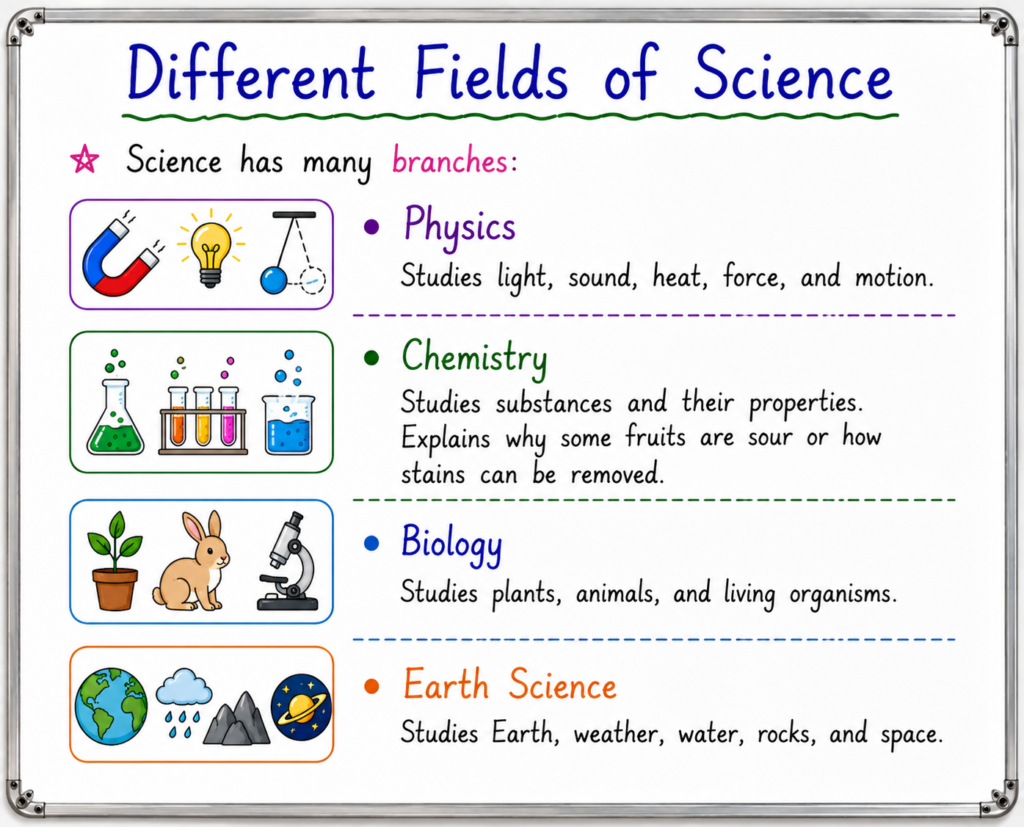
• Science is everywhere: in the kitchen, playground, oceans, deserts, mountains, and galaxies.
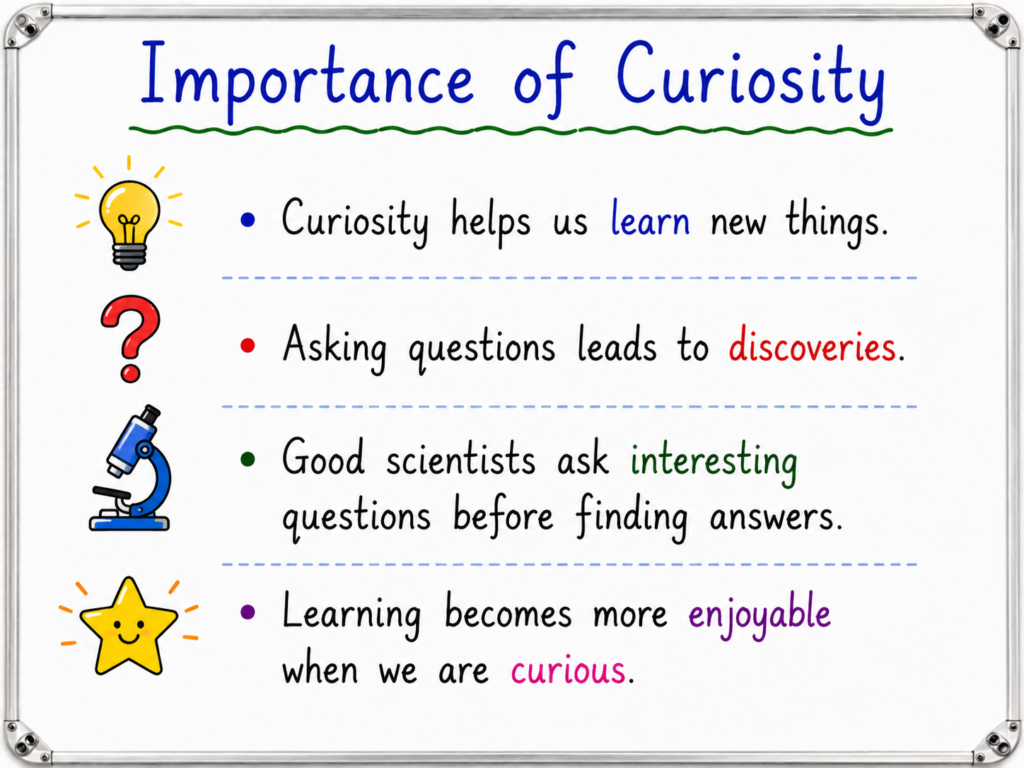
• The book emphasises Curiosity—asking why and how. Anyone who follows the scientific method is “working like a scientist”.
• Scientific Method (simple flow): Observe → Question → Hypothesis (guess) → Experiment/More Observations → Analysis → Conclusion.
• We explore: Earth (only known planet with life), diversity of life, food, water, materials, heat & temperature, and the sky (Sun, Moon, stars).
• Teamwork matters: scientists often work in collaboration. Keep asking questions and enjoy the journey!
🔴 20 One-Word Answer Type – Questions & Answers
Q1. What is the new subject that continues our exploration?
Science
Q2. What quality is most important to begin science?
Curiosity
Q3. Which planet is known to support life?
Earth
Q4. Which method does science follow?
Scientific
Q5. The first step of the scientific method?
Observation
Q6. The guess we test in science is called?
Hypothesis
Q7. What do we perform to test a hypothesis?
Experiment
Q8. What do we draw after analysis?
Conclusion
Q9. What shines in the night sky?
Stars
Q10. What is frozen water called?
Ice
Q11. What is water vapour from boiling water?
Steam
Q12. What measures hotness or coldness?
Temperature
Q13. What provides energy to do work?
Food
Q14. What is essential for survival besides food?
Water
Q15. A huge group of stars is called?
Galaxy
Q16. People who do science professionally are?
Scientists
Q17. Things we are surrounded with are made of?
Materials
Q18. Asking “why” and “how” develops?
Inquiry
Q19. Working together in science is called?
Collaboration
Q20. Science is compared to a giant?
Puzzle
🔴 20 Very Short Answer Type – Questions & Answers (1–2 lines)
Q1. What is science in simple words?
A way of understanding the world by observing, asking questions, and testing ideas.
Q2. Why is curiosity important in science?
It makes us ask “why/how”, which starts the process of finding answers.
Q3. Name two places where science is found in daily life.
Kitchen and playground (also oceans, deserts, space).
Q4. What does the book compare science to and why?
A jigsaw puzzle—each discovery adds a new piece and new questions.
Q5. List the simple steps of the scientific method.
Observe → Question → Hypothesis → Experiment → Analysis → Conclusion.
Q6. Give one example of using scientific method in daily life.
Finding why a pen stopped writing: check ink, test again, conclude.
Q7. What is special about Earth?
It’s the only known planet that supports life.
Q8. What do we study about food in science?
What it’s made of and how to identify its components.
Q9. What happens to water when cooled or heated?
It freezes into ice on cooling and becomes steam on heating.
Q10. How do we sense hot and cold scientifically?
By measuring temperature instead of only “feeling”.
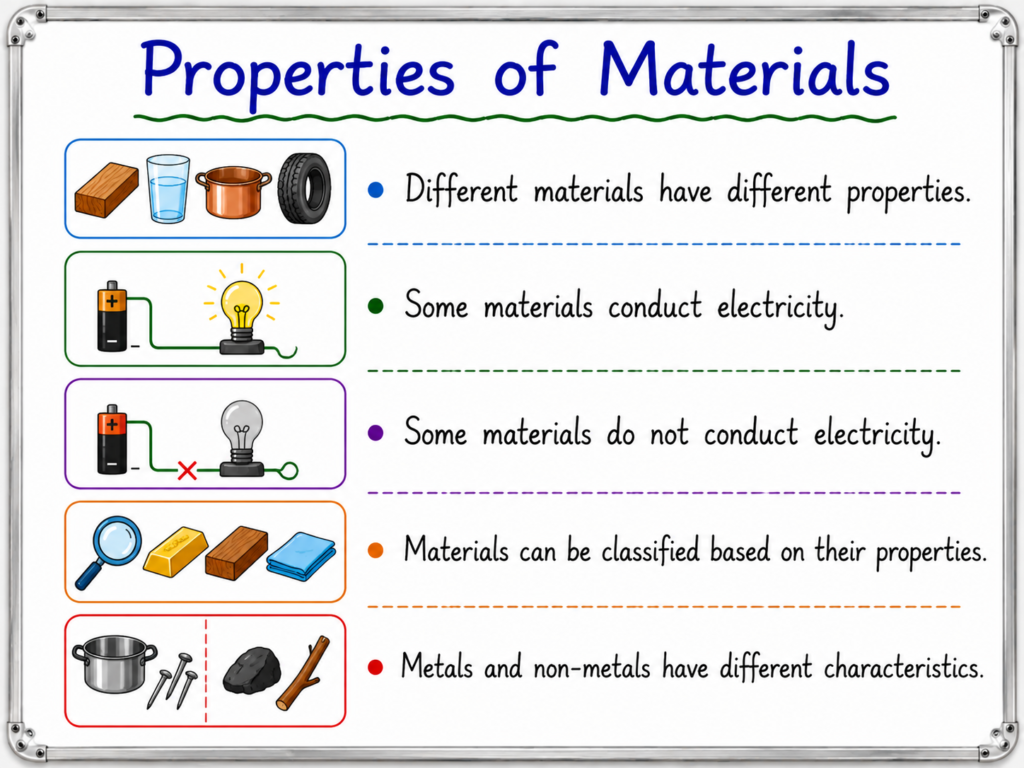
Q11. How do materials around us differ?
They are made of different substances with different properties.
Q12. Why does science often change earlier ideas?
New discoveries correct or improve past understanding.
Q13. How does teamwork help in science?
Different people share ideas and skills to solve complex problems.
Q14. What does looking at the night sky make us ask?
Questions like “Why do stars shine?” or “How does the Moon change?”
Q15. What is meant by ‘analysis’?
Examining results to check if they answer the question.
Q16. What is a hypothesis?
A testable guess about the answer to a question.
Q17. Name two natural regions mentioned.
Desert and coast (also mountains, oceans).
Q18. What everyday roles can use scientific thinking?
Cooks, electricians, bicycle repairers—anyone troubleshooting.
Q19. What attitude should we keep while learning science?
Stay curious, enjoy exploring, and don’t fear new questions.
Q20. Why won’t all answers come in Grade 6?
Science is a journey; deeper ideas come in later classes.
🔴 20 Short Answer Type – Questions & Answers (about 2–3 lines)
Q1. Explain why science is called an “unending puzzle”.
Each discovery solves one part but opens new questions. Thus the puzzle grows and our understanding keeps improving.
Q2. How does curiosity lead to learning?
Curiosity makes us observe and ask “why/how”. That begins investigation, experiments, and understanding.
Q3. Describe a simple daily-life investigation using the scientific method.
If milk overflows, ask “why”; hypothesize “too much heat”; test by lowering heat; analyze outcome and conclude.
Q4. Why is teamwork important in science?
Complex questions need varied skills. Collaboration speeds discovery and reduces errors.
Q5. What areas will this book help us explore?
Earth and its environment, living diversity, food, materials, water, heat & temperature, motion, and the sky.
Q6. What do we learn from the example of the pen that stops writing?
We form a hypothesis (empty ink), test it, and if wrong, form a new one—this is scientific thinking.
Q7. How can water changes (ice/steam) be used to teach science?
They show state changes with temperature, encouraging measurement and careful observation.
Q8. Why is measuring temperature better than touching to judge hotness?
Touch can be misleading; a thermometer gives accurate numerical values.
Q9. How do materials in our surroundings raise scientific questions?
Different properties (paper, metal, plastic) make us ask what they’re made of and how to separate them.
Q10. Why do scientific ideas sometimes change?
New evidence can show a better explanation, so old ideas may be corrected.
Q11. Give two examples of “science everywhere”.
Cooking processes in the kitchen; motion and forces on the playground.
Q12. What does “analysis” look like in a small experiment?
Comparing results to the hypothesis; checking patterns; deciding whether the guess was right.
Q13. Why is asking “why” about nature valuable?
It reveals hidden patterns, from star light to blooming flowers, leading to deeper understanding.
Q14. How does the book connect different ideas?
As we learn topics, we see they relate—food, materials, water, heat—building a connected picture.
Q15. What is meant by “testing a hypothesis”?
Designing observations/experiments to gather evidence that supports or rejects the guess.
Q16. Why is Earth’s environment worth protecting?
It uniquely supports life; protecting it safeguards biodiversity and human well-being.
Q17. How do cuisines show scientific curiosity?
We can ask what dishes are made of, how ingredients interact, and how methods change taste/texture.
Q18. What’s the role of failure in science?
If a guess fails, we learn and refine our ideas—failure guides better questions and tests.
Q19. Why is it okay not to know all answers in Grade 6?
Science builds year by year; foundations now enable advanced learning later.
Q20. Mention two natural regions and one question each you could ask.
Desert: how do plants conserve water? Coast: how do tides affect life?
📚 Textbook Exercise – Questions & Perfect Answers
Q1. Why is science described as a “giant and unending jigsaw puzzle”?
Every discovery adds a piece and leads to more questions. Sometimes old pieces are moved—ideas change with new evidence.
Q2. State the steps of the scientific method used in the chapter.
Observation → Question → Hypothesis (guess) → Experiment/More Observations → Analysis → Conclusion.
Q3. Give a daily-life example where someone used the scientific method.
A cook checks why dal spills from the cooker—hypothesis: too much water/heat; test by reducing water/heat; analyze and conclude.
Q4. How does curiosity help us learn science effectively?
Curiosity makes us observe carefully, ask “why/how”, try ideas, and learn from results—this is the heart of science.
Q5. What will you explore with the help of this book?
Planet Earth and its environment, variety of life, food, materials, water and its states, heat & temperature, motion, Sun–Moon–stars.
Q6. Why do scientific ideas sometimes get corrected?
New discoveries provide better explanations, so earlier conclusions are updated for accuracy.
Q7. Explain with examples how science is present “everywhere”.
From cooking changes in the kitchen to motion in sports, from deserts/coasts to galaxies—science explains all.
Q8. What are the changes observed in water with temperature?
On cooling, water freezes into ice; on heating, it boils and produces steam (water vapour).
Q9. Why should we use instruments like thermometers?
Feeling can be misleading; instruments measure accurately and help compare results.
Q10. How do materials around us raise scientific questions?
Different objects (paper, metal, plastic, rubber) suggest questions about composition and separation methods.
Q11. How can teamwork improve scientific investigations?
Teams share skills and ideas, making investigations faster, safer, and more reliable.
Q12. What attitude should you keep during your scientific journey?
Be joyful, keep exploring, work with others, and never stop asking questions.
Q13. (Activity 1.1) Write a similar problem you solved and steps taken.
Example: Bicycle tyre flat—question cause; hypothesis: puncture; test by air check; find leak; patch; conclude repair works.
Q14. (Activity 1.2) Describe a daily-life situation showing the scientific method.
Bulb not glowing—hypothesis: faulty bulb or switch; test with new bulb and different switch; analyze which part failed.
Q15. (Activity 1.3) Ask a “Why?” question and outline how you’d find the answer.
Why do leaves wilt in heat? Observe timing; hypothesize water loss; measure soil moisture; test by watering; compare results; conclude.
🎯 Quick Reminder
All questions are in red and answers in green. Meanings of vocabulary are in Hindi only, as requested. Everything else is in English. Page uses Comic Sans MS and a colorful, mobile-friendly layout with a finest black outline and full page stretch.